
When someone is prescribed an antidepressant or an anxiety medication, one of the first questions many people ask is how do antidepressants work?
“What is this actually doing to my brain?”
That’s more than curiosity — it’s about trust, safety, and understanding how treatment interacts with brain chemistry, time, and experience.
Instead of vague explanations, we’ll walk through what science actually shows: the nuts and bolts of neurotransmitters, reuptake, receptors, time courses, and why effects often take weeks to show up.
Brain Communication 101: Neurotransmitters and Signaling
Your brain contains billions of nerve cells (neurons) that communicate with each other constantly. This communication is what allows you to think, feel emotions, move your body, and respond to the world around you.
Neurons communicate using neurotransmitters, which are chemical messengers that carry signals from one nerve cell to another.
At the end of the neuron, an electrical signal triggers the release of neurotransmitters. These chemicals travel across a tiny gap called the synapse and bind to receptors on the next neuron.
Once the neurotransmitter reaches the next neuron, it can either activate or inhibit that cell, influencing how signals move between extensive networks of neurons in the brain.
What Neurotransmitters Control
Because this communication system runs throughout the nervous system, neurotransmitters help regulate many essential body functions, including:
- Heart rate and blood pressure
- Breathing
- Muscle movement
- Thoughts, emotions, and memory
- Sleep cycles
- Stress responses
- Hormone regulation
- Digestion and appetite
- Sensory experiences (what you see, hear, feel, and taste)
In other words, neurotransmitters are central to nearly everything the brain and body do.
Why Neurotransmitters Matter for Mental Health
Changes in neurotransmitter activity can influence mood, anxiety, attention, and motivation. For example:
- Serotonin helps regulate mood and emotional stability.
- Norepinephrine plays a role in alertness and the stress response.
- Dopamine is involved in motivation, reward, and pleasure.
Neurons release neurotransmitters like serotonin, norepinephrine, dopamine, and GABA. As described earlier, these chemicals bind to receptors on neighboring neurons to pass messages. Afterward, many neurotransmitters are pulled back into the original neuron in a process called reuptake.
Medications for mood and anxiety work by altering how these processes happen — not by “creating” feelings, but by changing the availability and effects of these messenger chemicals.
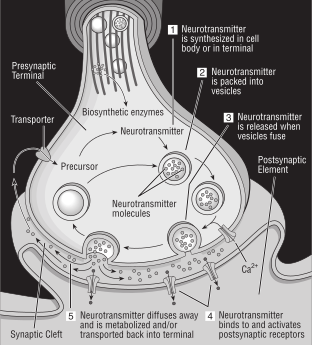
Figure 1. Neurotransmitter release and reuptake at synapse. (Image source: Wikimedia Commons.)
SSRIs: The Science Behind the Most Common Antidepressants
Selective Serotonin Reuptake Inhibitors (SSRIs) are among the most frequently prescribed medications for depression and anxiety.
Common examples include:
- Sertraline (Zoloft)
- Fluoxetine (Prozac)
- Escitalopram (Lexapro)
- Paroxetine (Paxil)
SSRIs work by blocking the reuptake of serotonin, a neurotransmitter involved in mood, emotion, and regulation.
When you take a medication like Prozac, a Selective Serotonin Reuptake Inhibitor (SSRI), the molecules in the medication bind to transporter proteins, blocking the reuptake (reabsorption) of this neurotransmitter, serotonin, and increasing its availability in the synaptic cleft, thereby enhancing neurotransmission to improve mood and reduce anxiety.
When SSRIs block reuptake:
- Less serotonin gets pulled back into the presynaptic neuron.
- More serotonin stays in the synaptic cleft.
- That increases the likelihood that serotonin will bind to postsynaptic receptors.
- More receptor activation = stronger signaling between neurons.
In simple terms:
More serotonin in the synapse → more receptor activation → stronger or more sustained signal transmission.
What ultimately happens is enhanced communication between neurons:
- Increased serotonin enhances signaling in circuits involved in:
- Mood regulation (prefrontal cortex)
- Threat detection (amygdala)
- Emotional regulation (limbic system)
- Over time, repeated increased signaling leads to:
- Receptor adjustments (downregulation of certain autoreceptors)
- Increased neuroplasticity or the reoganization of new neural connections.
- Strengthening of regulatory pathway
Neuroplasticity and Brain Change
That’s why antidepressants take weeks to work — it’s not just chemical increase, it’s circuit adaptation. The good news is that our brain can change and improve.
Over time, these strengthened signals promote neuroplastic changes that improve emotional stability and resilience. Essentially, the medication encourages our brain to learn and adapt by making physical changes (rewiring) in ways that enhance neural communication and promote the growth of new neurons, thereby having a positive impact on things such as mood and anxiety.
Notedly, research suggests that a similar process of neuroplastic adaptation and growth or rewiring of our neuronal networks can occur over the course of psychotherapy, further supporting the recommendation for combined treatment of therapy and medication.
SNRIs and Their Dual Action
Serotonin-Norepinephrine Reuptake Inhibitors (SNRIs) — like venlafaxine and duloxetine — work similarly to SSRIs but also target norepinephrine, another key neurotransmitter involved in alertness and stress responses.
By increasing both serotonin and norepinephrine availability, SNRIs may help symptoms related to:
- motivation
- concentration
- energy levels
This dual target can be helpful in certain profiles of depression and anxiety.
Anti-Anxiety Medications: Quick Relief Versus Long-Term Strategies
For anxiety disorders — including panic disorder and generalized anxiety — several classes of medications are commonly used. SSRIs and SNRIs are often considered first-line treatments.
Benzodiazepines
Benzodiazepines (like alprazolam, clonazepam, and diazepam) act on GABA, the brain’s primary inhibitory neurotransmitter. These drugs enhance GABA’s calming effect by increasing chloride influx in neurons, which dampens firing. Essentially, telling the neurons to slow down the alarm signal.
This is why benzodiazepines often work fast — within minutes — making them useful for acute anxiety or panic symptoms. However:
- They are not ideal for long-term use due to tolerance and dependence risk.
- They do not address the underlying neural adaptation associated with anxiety over weeks and months.
Other anxiety medications — like buspirone — work differently and more gradually by influencing serotonin receptors without heavy sedation.
Why Medication Effects Take Time
As described earlier, one confusing reality is that chemical changes in the brain can happen quickly — but the therapeutic benefits or adaptation often takes weeks.
This delay is not a flaw in the medication. It reflects how the brain adapts as described earlier in our discussion of SSRI’s.
When neurotransmitter levels change:
- Receptor sensitivity adjusts.
- Neural circuits recalibrate.
- Connectivity between regions related to mood and stress evolves.
Research has shown that these receptor and network adaptations, not the immediate serotonin increase, explain why mood improvements take time to develop.
Again, this insight is why effective treatment often combines medications with therapy: medication lowers activation and therapy helps the brain integrate change in lived experience.
Clinical research suggests that longer-term medication use may enhance how neurons connect across regions involved in emotion and cognition, which helps explain persistent improvements in mood and resilience over time.
The “Chemical Imbalance” Idea — What Research Really Says
A commonly repeated explanation is that depression equals a simple “chemical imbalance” — especially low serotonin.
The reality is more nuanced.
While serotonin and other neurotransmitters clearly play major roles in mood regulation, the idea that mood disorders are caused by a simple deficiency is controversial and oversimplified. Some researchers describe the classic chemical imbalance model as a simplified cultural narrative rather than a complete scientific explanation.
Current understanding emphasizes that mood disorders involve:
- neurotransmitter signaling
- stress hormone systems
- neural circuitry
- plasticity
- life experiences
It’s this broader picture — not a single chemical deficit — that shapes modern psychiatry.
Combining Therapies: Medication + Psychotherapy
Clinical guidelines for anxiety disorders consistently recommend a combination of medication and talk therapy, especially for conditions like generalized anxiety disorder, major depressive disorder, panic disorder, and PTSD.
Clinical guidelines for anxiety therapy consistently recommend a combination of medication and talk therapy, especially for conditions like generalized anxiety disorder, panic disorder, and PTSD.
For individuals struggling with low mood or persistent sadness, combining medication with depression therapy may also improve long-term outcomes.
Medication can make experiences less overwhelming, which allows psychotherapy for anxiety — whether cognitive-behavioral, psychodynamic, or another evidence-based approach — to be more effective.
Men, in particular, sometimes benefit from an integrated approach that includes both medication management and therapy for men, especially when anxiety presents as irritability, overwork, or emotional shutdown.
Medication can make experiences less overwhelming, which allows psychotherapy — whether cognitive-behavioral, psychodynamic, or another evidence-based approach — to be more effective.
In other words:
- Medication adjusts biology and neuroplactic growth.
- Therapy reshapes patterns and further supports neuroplactic changes.
- Together, they enhance overall growth and resilience.
In my article on When Worry Pretends to Protect Us, I explore deeper questions related to anxiety and therapy for anxiety.
What About Withdrawal or Discontinuation?
Some medications — especially those with shorter half-lives — can cause discontinuation symptoms if stopped abruptly. This is not a relapse of depression or anxiety, but a neurochemical adjustment as the brain readapts to the absence of medication.
That’s why clinicians typically recommend gradual tapering when stopping medications, especially SSRIs or SNRIs.
Final Takeaways
- SSRIs and SNRIs work by increasing availability of key neurotransmitters like serotonin and norepinephrine, and therapeutic effects take time because the brain adapts slowly to these changes.
- Benzodiazepines provide fast calming by enhancing GABA, but are usually used short-term due to tolerance risk.
- The simplistic “chemical imbalance” model is outdated; mood disorders reflect complex neural network dynamics and adaptation via neuroplasticity.
- Medication can reduce intensity and support therapy, but it doesn’t erase personal history or meaning — it creates space for integration and change.
Dr. Thomas Lindquist, Psy.D.
Licensed Psychologist
Frequently Asked Questions About Antidepressants and Anxiety Medications
How do antidepressants actually work in the brain?
Most antidepressants (like SSRIs and SNRIs) work by blocking the reuptake of neurotransmitters such as serotonin and norepinephrine. This keeps more of these chemicals available in the synapse, allowing brain circuits involved in mood and stress regulation to gradually recalibrate, grow, and change over several weeks.
Why do antidepressants take weeks to work?
While neurotransmitter levels change quickly, mood improvement depends on slower processes like receptor adaptation and neuroplasticity. The brain needs time to adjust to new signaling patterns, which is why full effects typically appear after 4–6 weeks.
Are anti-anxiety medications addictive?
Some medications — particularly benzodiazepines like Xanax or Ativan — can lead to tolerance and dependence if used long-term. However, SSRIs and SNRIs, which are commonly prescribed for anxiety in Pittsburgh and nationwide, are not considered addictive.
Do antidepressants change your personality?
When properly prescribed, antidepressants typically reduce excessive anxiety, rumination, or depression.
Is depression just a chemical imbalance?
Modern research shows depression and anxiety are more complex than a simple serotonin deficiency. They involve neurotransmitters, stress hormones, neural circuits, life experiences, psychological and attachment history. Medication adjusts signaling but does not erase psychological meaning.
If you’re considering medication, therapy, or both, you can learn more about our approach to anxiety therapy, depression therapy, and therapy for men here in Pittsburgh.


